Integrations
Connect RabbitQA with your existing tools and workflows.
What are Integrations?
Integrations connect RabbitQA with your existing development and project management tools, enabling seamless workflows and data synchronization across your entire ecosystem.
Configure integrations once at the platform level, and they become available across all RabbitQA modules.
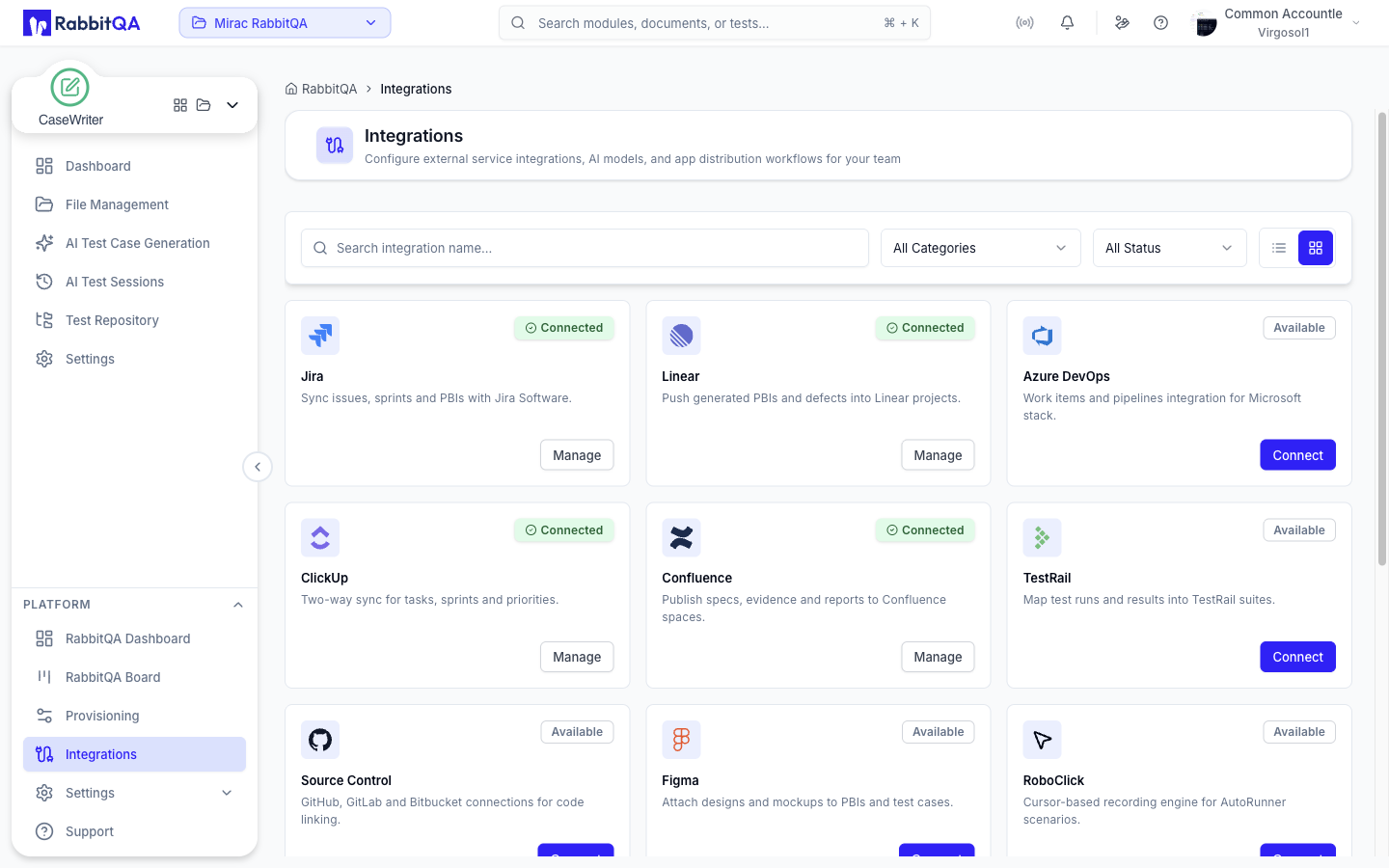
The catalog
The Integrations page groups what you can connect:
| Group | Integrations |
|---|---|
| Project Management | Jira, Linear, Azure DevOps, ClickUp, Confluence |
| Test Management | TestRail |
| Source Control | Azure DevOps, Source Control |
| Design | Figma |
| Automation & Runners | RoboClick, Runners |
| Platform & AI | AI Models, Tools, App Distribution |
A search box filters by integration name, and a status filter narrows the catalog to Connected or Available. The sections below cover the ones most teams set up first.
Jira Integration
Connect RabbitQA with your Jira instance to enable bidirectional synchronization of issues, PBIs, and test results.
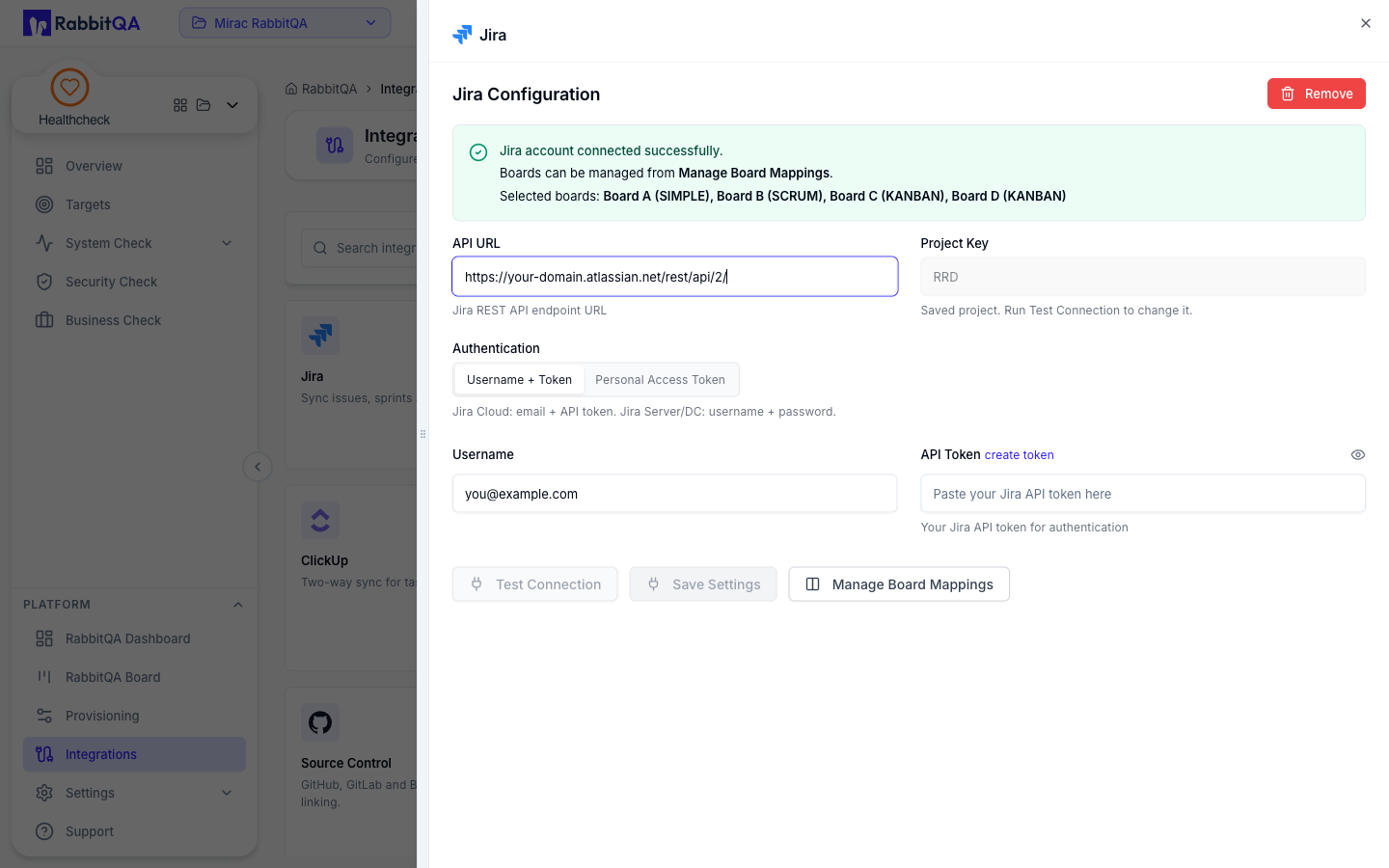
Configure by entering your Jira instance URL, a project, and credentials.
Two authentication modes are offered: Username + Token for Jira Cloud (email plus API token) or Jira Server/DC (username plus password), and Personal Access Token for Jira Server/Data Center, which takes a token alone and hides the username field.
Jira Cloud does not support Personal Access Tokens; the form warns you when the URL is an atlassian.net one and PAT mode is selected.
Use Test Connection to verify before saving.
Once connected, Smart PBI exports generated backlog items to Jira and links existing issues, TestPilot creates defects from failed executions and renders a Jira board, and CaseWriter links test cases to Jira requirements.
Azure DevOps Integration
Integrate with Azure DevOps to sync work items, test results, and project data between RabbitQA and your Azure DevOps organization.
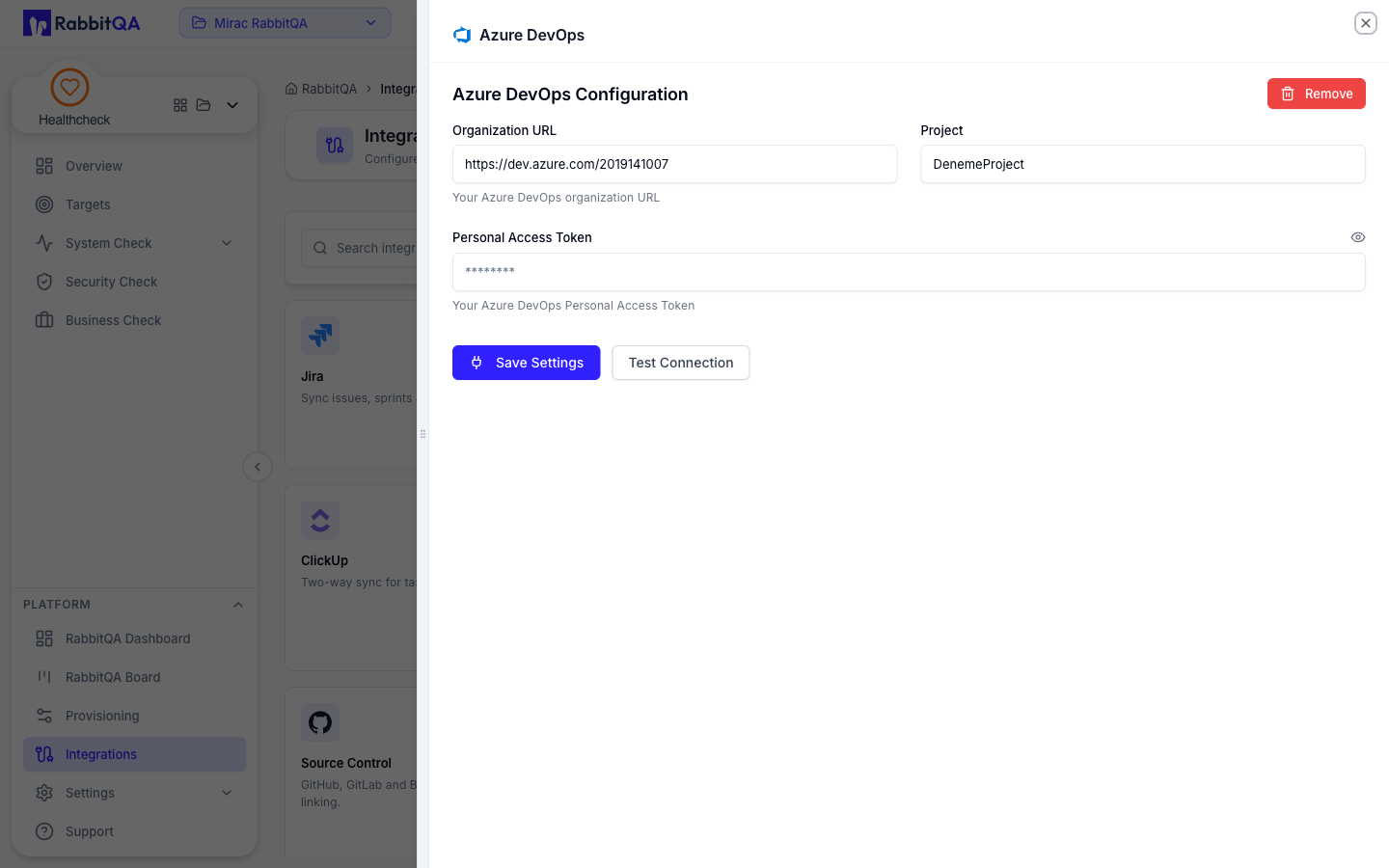
Set up by providing your Azure DevOps organization URL, a project, and a Personal Access Token (PAT). This enables Analyzer to export PBIs as work items, TestPilot to create bugs from test failures, and CaseWriter to maintain traceability with Azure DevOps requirements.
Connection Setup
The Azure DevOps integration form collects three values:
| Field | Description |
|---|---|
| Organization URL | Your full Azure DevOps organization URL, for example https://dev.azure.com/yourorg. Required. |
| Project | The Azure DevOps project that work items, boards, and pipelines belong to. Required. |
| Personal Access Token | Displayed as a masked password field with a show/hide toggle. Must be at least 6 characters. |
Use Test Connection before saving to verify the credentials reach Azure DevOps. Failed connections surface the underlying Azure error so you can correct scope or expiration issues without leaving the page. Once connected, a Remove button clears the integration.
The integration is gated behind the azureDevOpsEnabled feature flag, which lets administrators
disable Azure DevOps per deployment without removing the credentials.
Creating Work Items from Test Failures
When TestPilot promotes a failed step to a bug, RabbitQA opens a multi-step Azure DevOps issue modal that walks through:
- Project selection — Pick any Azure DevOps project the connected PAT can reach.
- Work item type — Choose Bug, Task, Feature, User Story, or any custom type defined in the selected project's process template.
- Dynamic field schema — RabbitQA fetches the full field schema for the chosen work item type, including required, optional, and custom fields. You only see fields that actually exist on that work item type, with their allowed values and defaults pre-populated from Azure DevOps.
The form supports every Azure DevOps field type:
| Field type | Behavior |
|---|---|
| Single-line / multi-line text | Plain text input, length validated against Azure schema. |
| HTML / rich text | Description-style fields accept rich text; plain input is auto-wrapped in HTML. |
| Multi-select (tags, related items) | Array fields render as multi-select with allowed values from the schema. |
| Identity (assignee, reviewer) | Dropdown of project members with an explicit "Unassigned" option. |
| Date / DateTime | Native date picker for due dates, target dates, and scheduling fields. |
| Integer / decimal | Numeric inputs with the precision Azure DevOps expects. |
| Boolean | Checkbox for true/false flags on custom fields. |
When you re-open an existing Azure DevOps issue, the modal pre-fills every field — including the
project and work item type — from the work item's fields payload, so edits are made against the
real current state instead of stale cached values.
Priority Mapping
RabbitQA's four-level severity scale is automatically translated to Azure DevOps' numeric 1–4 priority field, with display labels preserved on both sides:
| RabbitQA priority | Azure DevOps priority | Display label |
|---|---|---|
| Critical | 1 | 1 - Critical |
| High | 2 | 2 - High |
| Medium | 3 | 3 - Medium |
| Low | 4 | 4 - Low |
Attachments
Each Azure DevOps work item supports up to 10 attachments of 10 MB each through the RabbitQA modal. The attachment panel handles three operations against the same work item:
- Upload new screenshots, logs, or evidence captured during test execution.
- Preview existing attachments — images and PDFs stream inline; Office documents open through Azure's tokenized download URL.
- Remove attachments that are no longer relevant; deletions are pushed to Azure immediately.
Hierarchical PBI Export
Smart PBI exports preserve the Epic → Feature → User Story hierarchy when targeting Azure DevOps. The export drawer renders the generated backlog as a parent-child tree with indeterminate checkbox state for partial selections, and creates the matching parent/child links in Azure so boards and queries reflect the same hierarchy as the RabbitQA Smart PBI view.
Confluence
Connect Confluence to use pages as source material instead of uploading files.
Once connected, Analyzer and Smart PBI can pick pages from the Confluence page tree as generation input.
CaseWriter and SmartRequest do not offer a Confluence picker in their generation wizards.
TestRail
Connect TestRail to bring existing cases, runs and results into the RabbitQA test repository, and to push execution results back.
Source control
Connect a repository provider so AutoRunner can read automation projects and CaseWriter can detect source changes worth regenerating tests for.
ClickUp and Linear
Connect ClickUp or Linear for issue tracking. TestPilot renders a ClickUp board alongside its own and can link existing ClickUp issues to executions.
AI Models
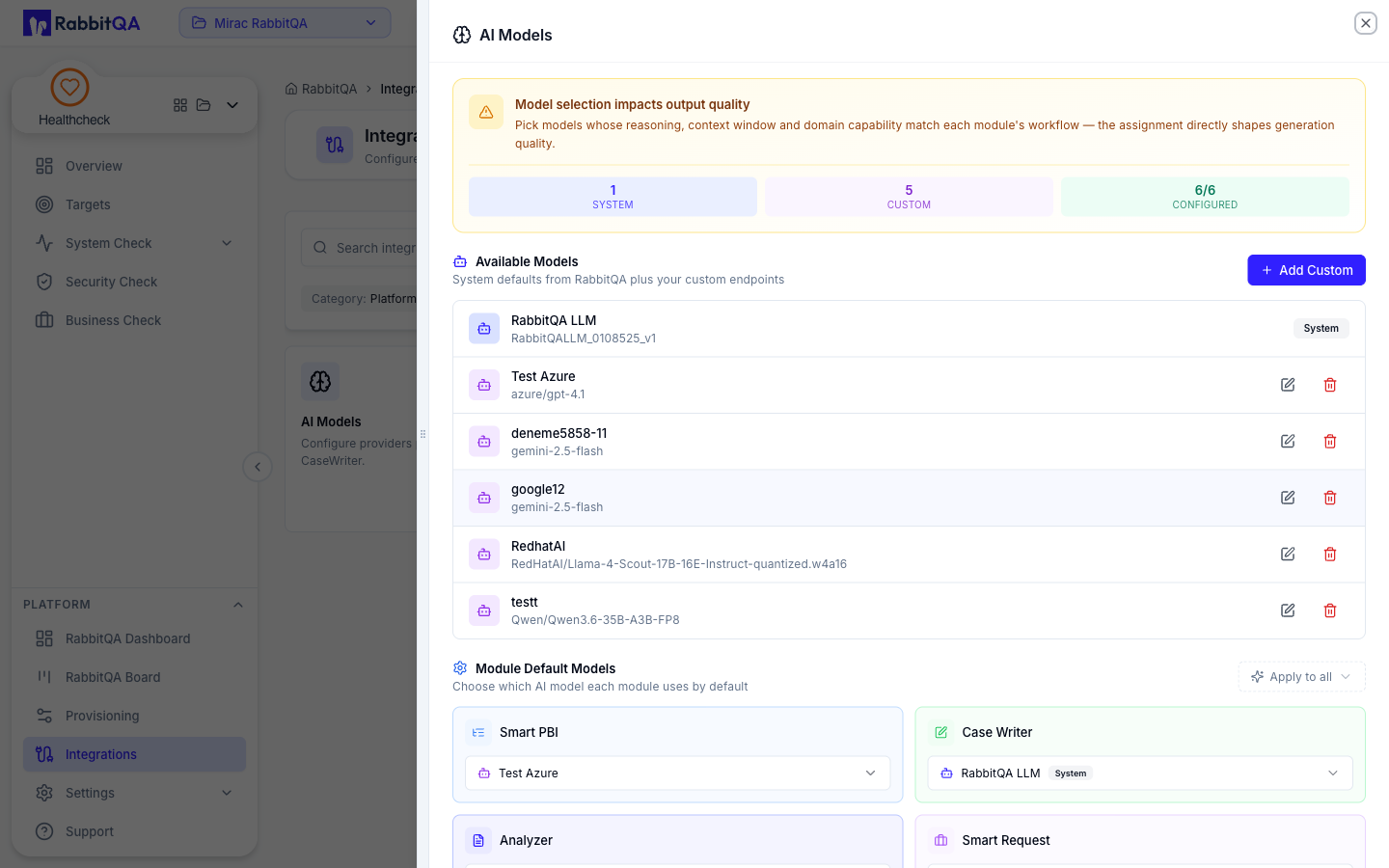
Choose and configure the models used for generation and analysis, including custom models alongside the system ones.
A default model is assigned per module, for Smart PBI, CaseWriter, Analyzer, SmartRequest, Accessibility and DataCrate. Only the modules your company actually has are listed.
AI generation consumes points. See Billing and Credits.
Managing Integrations
The Integrations page shows every connection and its current state. From there you can re-check a connection, edit its credentials, or disconnect it.
Disconnecting removes the integration for every module and every workspace at once, so check what depends on it first — a disconnected Jira takes the RabbitQA Board and TestPilot's Jira board with it.
