AutoRunner Module
AutoRunner is RabbitQA's test automation orchestration module. It enables teams to execute automated tests across multiple frameworks, write BDD scenarios in Gherkin syntax, integrate with CI/CD pipelines, and schedule recurring test runs — all from a centralized interface.
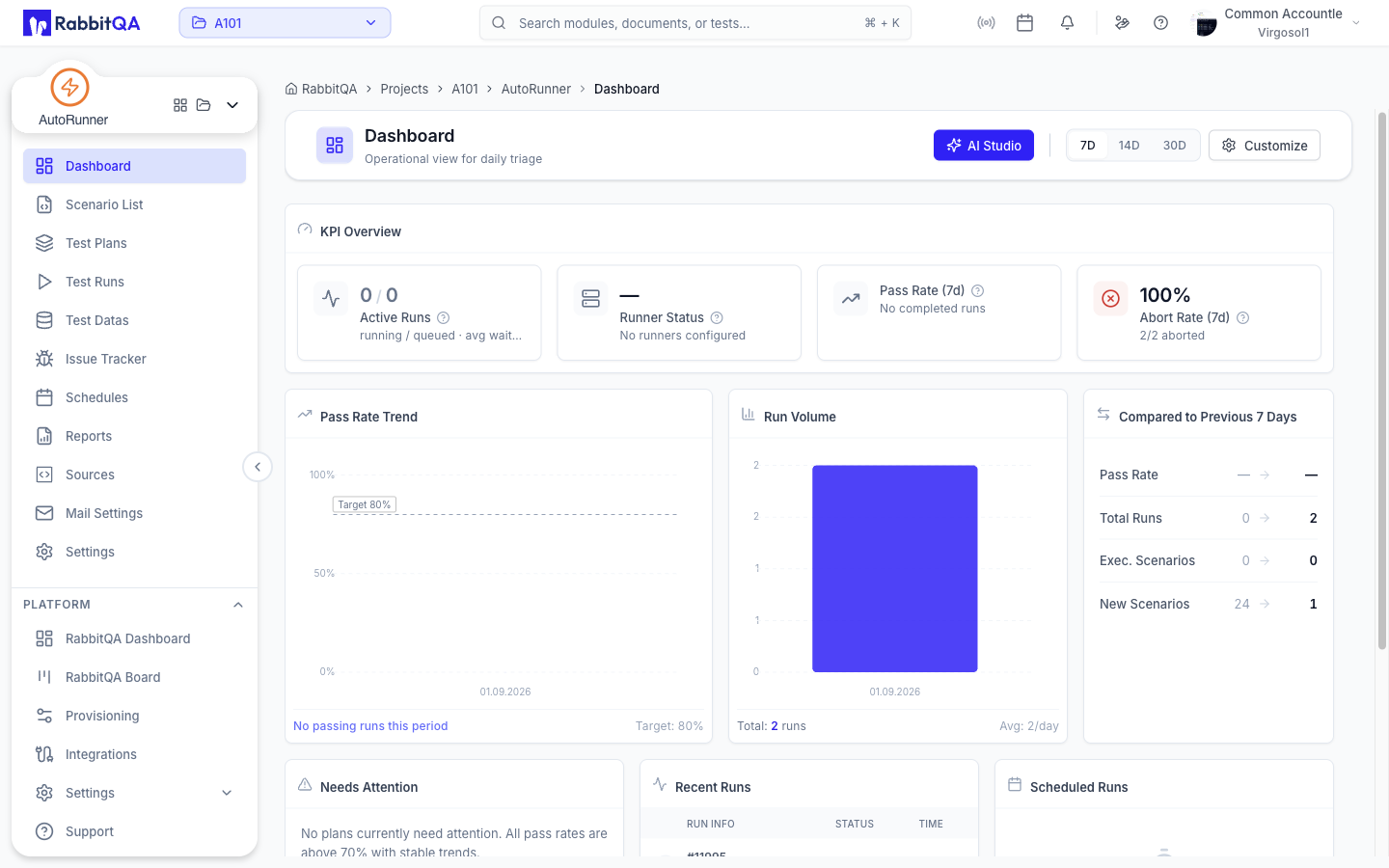
Key Capabilities
- Multi-Framework Execution — Run automated tests across 12 supported frameworks
- BDD Scenarios — Write and manage tests in Gherkin syntax with a built-in Monaco editor
- AI Studio — Generate and refine test scenarios using AI-powered assistance
- Code Editor — Full-featured Monaco editor with syntax highlighting, autocomplete, and live validation
- Test Suites — Organize scenarios into configurable suites with driver, environment, and tag controls
- CI/CD Integration — Trigger test runs from your deployment pipelines
- Scheduling — Configure recurring test runs on a schedule
- Runner Management — Register, configure, and monitor test execution engines
- Results Aggregation — Centralized reporting with pass/fail trends and detailed logs
- Project Health KPIs — Monitor test suite health with color-coded status indicators
Supported Frameworks
| Framework | Language | Support |
|---|---|---|
| Gauge | Multiple | Full |
| Cucumber | Multiple | Full |
| Postman | JavaScript | Full |
| Robot | Multiple | Full |
| AI Agent | Multiple | Full |
| SAP | Multiple | Full |
| Oracle | Multiple | Full |
| Logo Tiger | Multiple | Full |
| Recorder | Multiple | Full |
| JUnit | Java | Full |
| TestNG | Java | Full |
| xUnit | .NET | Full |
Quick Start
- Create a Project — Set up an automation project in Projects with your chosen framework.
- Organize Suites — Group your scenarios into Test Suites with driver and environment settings.
- Write Scenarios — Author BDD test scenarios in the BDD Editor or generate them with AI Studio.
- Edit Code — Use the built-in Code Editor for advanced scenario authoring and step definition editing.
- Run Tests — Execute tests and monitor results with the Test Runner.
- Analyze Results — Drill into Run Details for step-by-step logs, screenshots, and metrics.
- View Reports — Track trends and export reports in Reports.
- Configure Runners — Register and manage test execution engines in Test Runners.
- Automate — Set up CI/CD Integration or Scheduling for continuous testing.
ipucu
For a hands-on walkthrough, see the Quick Start Guide to create your first project, write a BDD scenario, and execute a test run in under 10 minutes.
